
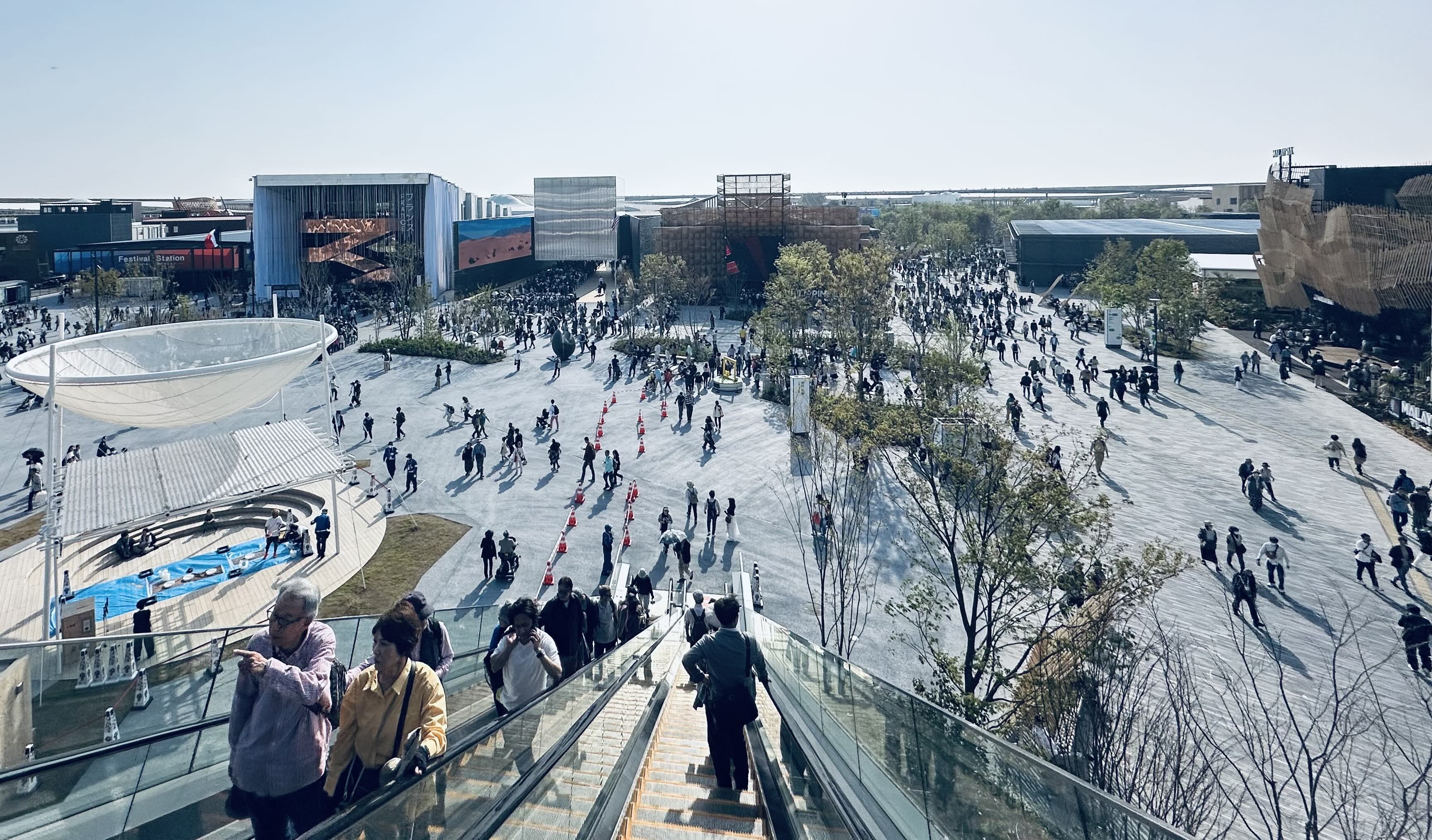
On event days, venue operations teams need to observe their environment in a heightened state of awareness, continuously checking if things are OK or not. Are we reaching capacity? Is the queue backing up? How full are the car parks? How are stock levels? Are we short-staffed? What are visitors complaining about right now?
But mostly they don’t have the data to answer those questions in the heat of the moment. Or see the dependencies between them.
The real-time venue gives the teams from operations, security, ticketing, retail, and venue leadership the data they need to understand what is happening right now.
For venue and event operations, that is ideally a few seconds from something happening to the information getting into the hands of the people who need it. It sounds easy, but is incredibly hard to achieve in practice. A retail transaction or a ticketing scan, for example, happens at the venue, but they are often processed in the cloud. So getting the right data from venue to cloud and back again, providing useful metrics and alerts to a control room or mobile device, is the challenge. While a latency of a few seconds is not the norm today for most venue systems, it is increasingly achievable and expected. Venue occupancy can only be regulated in real-time when that data is in the hands of the people at the entry points. Similarly, a minute is too long for an effective response to critical issues.
We benefit from sight, sound, smell, touch, and taste. It takes us up to half a second to see something, identify it, analyse, and decide what action (if any) to take. A little faster when we hear a sound. We have rich multi-modal sensory coverage, taking in enormous amounts of information about our environment, making sense of it quickly and applying judgment. But in a crowded, noisy environment, with obscured lines of sight, our effectiveness is very localised.
So there are control rooms to get the complete picture, but often the only live data they see are fragmented CCTV camera views and some siloed dashboards. Not flow rates, not crowd density, not venue capacity, not F&B sales, not car park capacity, not train arrivals, not customer feedback, not staff check-in, etc. Control rooms have a much lower sensory coverage than they should.
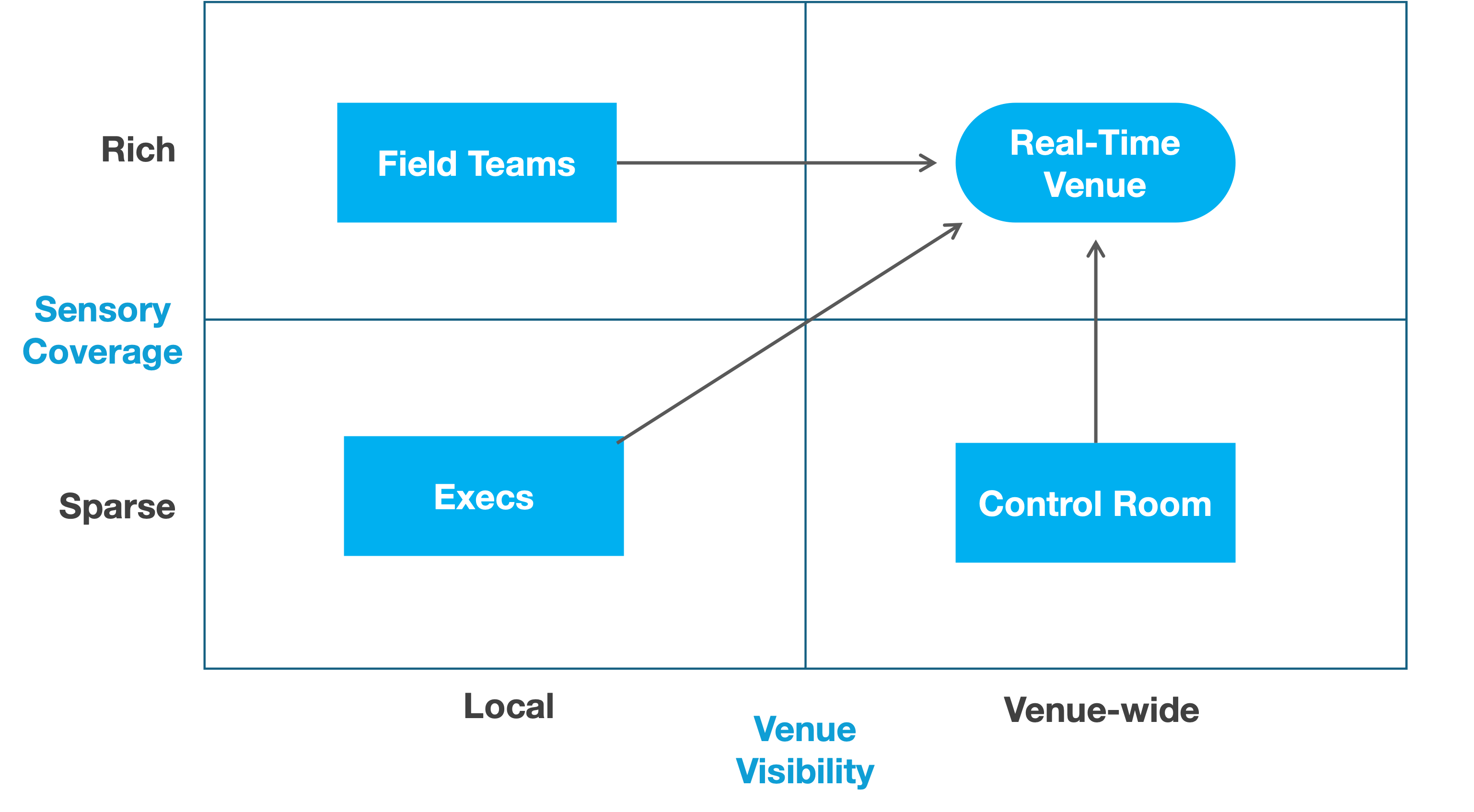
And what about the supervisors, operations managers, and leadership who are out and about across the venue? They rely on updates from field teams and control rooms, so they receive sparse information, with significant delays making it hard to grasp the real situation on the ground.
The real-time venue closes the gap for all stakeholders. It gives the control room live operational metrics across all functions in and around the venue; the field teams the data relevant for their role, and provides execs the visibility they need when talking to their stakeholders.
The short answer is as much as possible, but in a very focused way. The goal is total venue situational awareness, and typically that requires crowd analytics, ticketing access, transport & parking, retail sales, weather & environment, event schedule/run sheet, workforce scheduling, issue management, and customer feedback.
The goal is operational metrics that answer a few questions:
- How are we doing?
- Do we have a problem?
- What is the near-term forecast?
There are different venue stakeholders. A few need the complete picture, while others need to see only a slice relevant for their role.
If you can monitor whether your network or applications are up or down at any time and get an alert, why can’t you do the same for the physical operations at a venue? This is why we built Skylight: to be able to monitor the physical world. The value comes in taking action before a major issue occurs, or in responding immediately if it does. It comes in joining the dots across several areas to surface insights and forecast operations. It comes in not having to create manual reports at the end of each day. Beyond event day operations, that data can be used to drive performance improvements weekly. To increase sales, improve workforce productivity, and to provide a much more seamless and enjoyable experience for the fans.
All venues will eventually be real-time venues. Some will be innovators and early adopters, and others will take a use case by use case approach that will take a little longer to achieve complete operational visibility.
There are a lot of ways AI models help and a few ways that they can’t. AI models are great at analysing the data, summarising what happened, and identifying insights and anomalies. What they can’t do is the plumbing to get the data from venue sensors and systems, or reliably and efficiently process that with ultra-low latency to achieve real-time operations.
Beyond the event days, many venues operate 7 days a week. They have staff working onsite, they host meetings and conferences, they have coffee shops, restaurants, merchandise sales, and they run tours. When you get real-time capability in place for busy event days, that same capability can help to track performance for the rest of the week. That’s a bonus that can be exploited.
Venues that are serious about improving the performance of their operations and using that data to drive continuous improvement should have some data analysis capability in their team. Think of this as a Venue Performance Analyst or Venue Performance Engineer (depending on what you prefer). This role reviews the operational performance across all functions after the event and identifies areas for improvement the next week. Improvements which reduce visitor friction, improve safety, increase sales or optimise venue efficiency. That might be a role fulfilled by AI in future, but understanding the proprietary data that a venue generates is something that venues should invest in.
The real-time venue takes the guesswork out of running a venue and gives the operations team and leadership the capability to deliver consistently exceptional experiences. To know the current state of play, the current issues, the upcoming issues and what actions can be taken to improve commercial and operational performance.

