Operations teams at major events, venues and cities need to respond to critical issues in seconds. They need to identify the points of friction impacting customer experience and operational performance. But they are largely blind. They see only a fraction of what is happening, due to missing data and disconnected systems. So they rely on gut feel and experience, which works until it doesn’t. When situations escalate, when multiple issues hit at once, or when leadership asks “what's happening right now?” - the gaps become visible. And beyond the live operation, the same fragmented data makes it almost impossible to forecast accurately for the next event, or to identify the trends that can drive improvement.
What is an RTOP?
A Real-Time Operations Platform (RTOP) takes live data from across an operation - people, transport, environment, spaces - and fuses it into a single, actionable view.
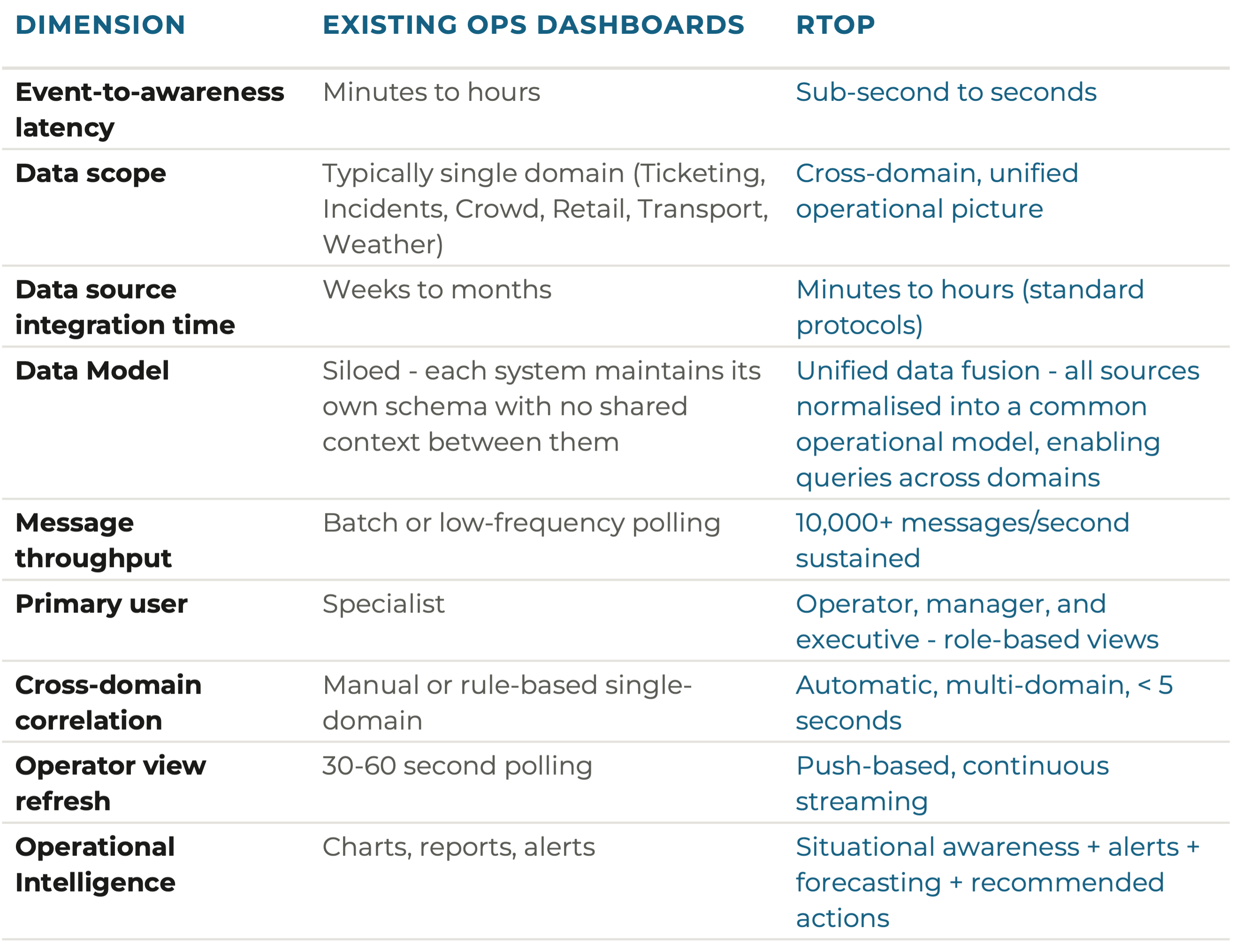
Unlike business intelligence tools that show what happened hours ago, or monitoring systems that track a single domain, an RTOP provides a continuous, cross-domain operational picture.
It delivers business-relevant metrics and insights to an operations centre and to field teams. It fires alerts and notifications when thresholds have been exceeded, and simplifies end-of-day reporting. The availability of real-time data improves forecasting both before and during operations, providing an ability to look a few minutes ahead or to the end of the day.
What problem does it solve?
A Real-Time Operations Platform solves several problems:
Obtaining a unified view of operations. Modern operations centres face a common problem: their operational data is scattered across dozens of disconnected systems. Security cameras feed into one platform. Access control lives in another. Retail sales run through a third. Environmental monitoring, crowd management, incident tracking, car parking, workforce scheduling - each has its own system, its own screen, and its own silo. Obtaining a complete operational view enables the operations team to better understand what’s actually happening on the ground and the impacts.
The ability to identify issues that are happening now to provide a faster response. E.g. over-crowding, low sales, full car parks, poor air quality, negative customer feedback, and late transport arrival. Not looking back at what happened an hour ago, or yesterday, but being able to provide answers to leadership in seconds when situations escalate or multiple issues occur simultaneously.
A focus on operational metrics, not just system dashboards that surface technical KPIs that are unable to help drive actions on the ground.
Extending visibility beyond the operations centre to field teams and execs on their mobile devices, so everyone is on the same page, closing the information gap.
Reducing the amount of time needed to create reports and identify trends and insights, eliminating the need to consolidate Excel files and combine different data sources.
The ability to model and forecast operational performance based on real-time data. Predictions can be updated every few minutes, removing guesswork and over-provisioning of resources.
Who needs one?
The common thread is operational complexity: multiple data sources, multiple stakeholders, time-critical decisions, and a need for coordinated response. The following signs indicate where a Real-Time Operations Platform will add value:
Operational staff are switching between multiple systems to understand what's happening.
When an incident occurs, the first 10 minutes are spent gathering information from different teams and systems, not responding.
When leadership asks "What's happening right now?" and the honest answer takes a phone call, a spreadsheet, and 15 minutes to compile.
You regularly over-provision or under-provision resources or inventory because you can’t forecast what you need.
Getting good reporting takes hours, and good analysis takes days.
Operational knowledge lives in the heads of experienced operators, and when they're not on shift, decision-making quality drops.
An RTOP doesn't replace existing systems. It makes them work together.
How does it differ from existing tools?
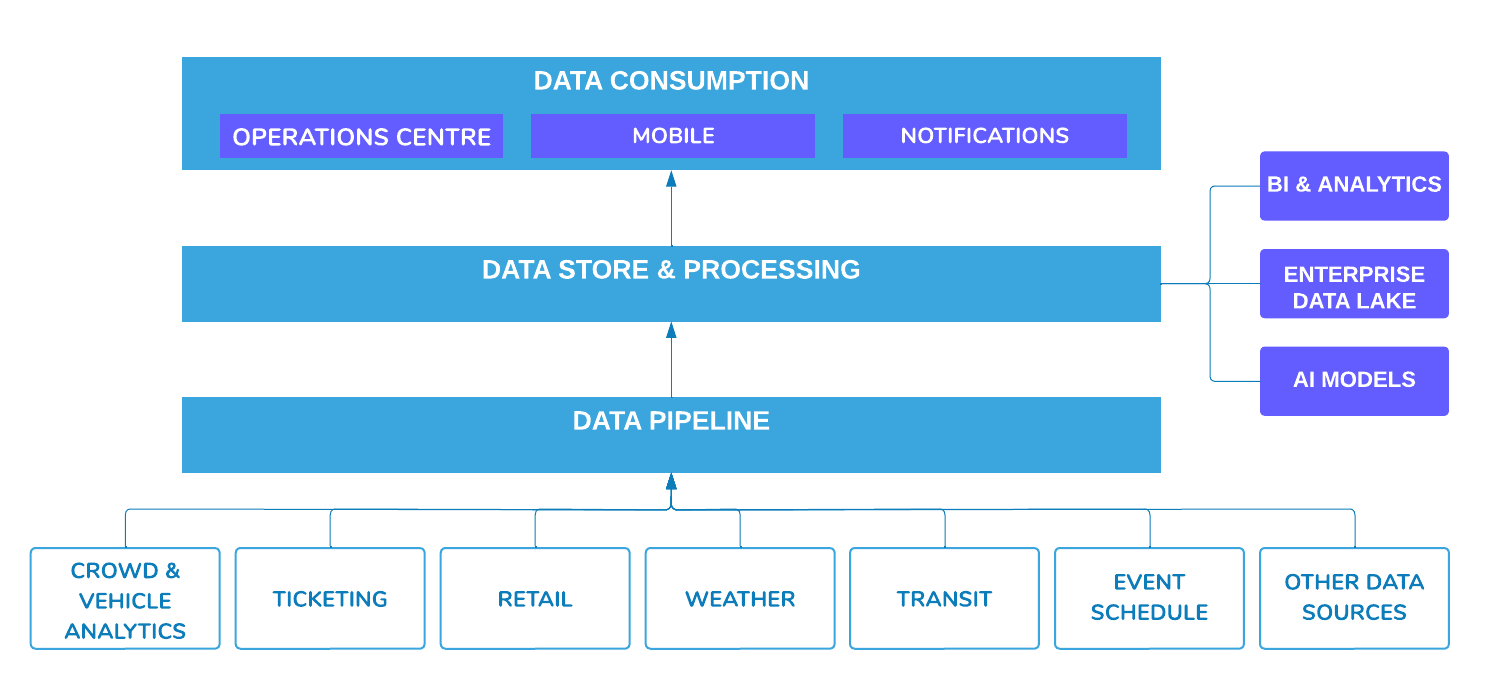
Components
At a conceptual level, the core components are outlined below.
Few solutions deliver end-to-end real-time operations. Most organisations will piece together a custom solution they need around one core ecosystem like Grafana, Databricks, Snowflake, Microsoft, Splunk or an open-source stack.
While drawing an architecture, defining the specifications and selecting software components can be relatively easy, achieving real-time operations in practice is hard. The biggest challenges with any custom build include the following:
A lack of cohesion across the components – some tools are good at monitoring, or as a data lake, or as a BI tool or for data analysis and forecasting. Getting a cohesive platform that operates as one is difficult.
Integrating data sources – like accurate video analytics, ticketing systems, transit systems, building systems, and environmental monitoring.
Measuring operationally relevant metrics - many systems show what data is available, rather than what the operations teams need.
Achieving an event-to-awareness latency of 1 – 3 seconds is difficult in practice.
Forecasting in live environments requires good historical and real-time data, together with robust and fine-tuned models.
The time taken to build, test and fine-tune a seamless end-to-end capability can be 8 – 12 months.
Implementation and operations costs can be high depending on the underlying software and implementation efforts.
The future of real-time operations
A Real-Time Operations Platform transforms fragmented monitoring into unified operational intelligence and turns reactive operations into proactive ones. The concept is simple. Achieving it is genuinely hard. But for organisations that get it right, the competitive advantage is significant - in faster response, better forecasting, and operations that improve every day.